
CCTV System Architecture
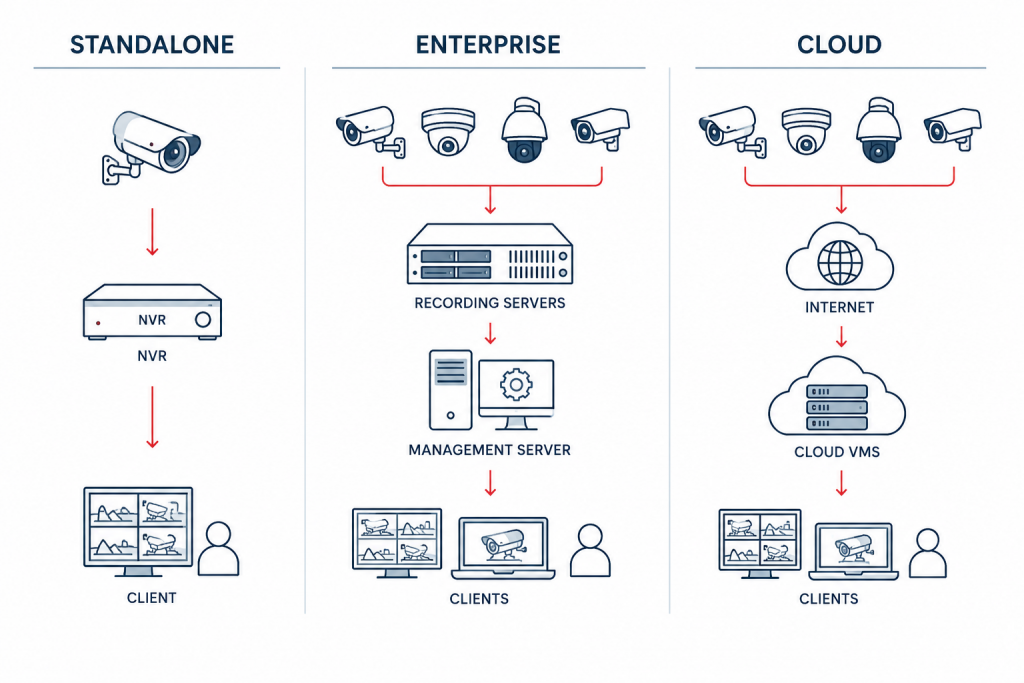
The architecture of a CCTV system determines where video is processed, managed, recorded and viewed. It has a significant influence on system scalability, resilience, network utilisation, maintenance requirements and operational cost. Selecting the correct architecture is therefore one of the earliest and most important design decisions.
Typical Applications
The size, complexity and operational requirements of a site will often determine the most appropriate architecture.
| Architecture | Typical Applications |
|---|---|
| Standalone DVR/NVR | Domestic properties, small retail units and small commercial premises. |
| Plug-and-Play NVR | Small to medium businesses requiring simple deployment with limited expansion. |
| Enterprise Server-Based VMS | Corporate campuses, hospitals, prisons, airports, utilities, manufacturing sites and multi-building estates. |
| Distributed Recording | Large estates, geographically dispersed organisations and sites connected by WAN links. |
| Centralised Recording | Single-site enterprise environments with robust network infrastructure. |
| Edge Recording | Remote locations, temporary installations and resilience applications. |
| Hybrid Cloud | Organisations requiring both local recording and cloud-based management or remote access. |
| Native Cloud | Small distributed estates, retail chains and organisations with minimal on-site infrastructure. |
Advantages and Disadvantages
Every architecture involves compromises.
| Architecture | Advantages | Disadvantages |
|---|---|---|
| Standalone DVR/NVR | Low cost, simple installation, minimal configuration. | Limited scalability, single point of failure, limited integration. |
| Plug-and-Play NVR | Easy deployment, automatic camera discovery, straightforward management. | Limited flexibility, proprietary ecosystems, expansion constraints. |
| Enterprise Server-Based VMS | Highly scalable, resilient, flexible, extensive integrations. | Higher capital cost, greater technical complexity, server infrastructure required. |
| Distributed Recording | Reduced WAN traffic, improved resilience, local autonomy. | More complex administration and maintenance. |
| Centralised Recording | Simplified management, central evidence repository, easier administration. | Greater dependence on network performance and central infrastructure. |
| Edge Recording | Maintains recording during network outages, reduced infrastructure requirements. | Limited storage capacity, evidence retrieval can be more complex. |
| Hybrid Cloud | Combines local performance with cloud accessibility and resilience. | Increased architectural complexity and ongoing subscription costs. |
| Native Cloud | Minimal on-site infrastructure, simplified updates, rapid deployment. | Reliance on Internet connectivity, recurring operational costs, bandwidth considerations. |
Scalability
Some architectures are intended for relatively static installations, while others are designed to support continual growth.
Standalone and Plug-and-Play NVRs are generally limited by appliance capacity and may require replacement once camera limits are reached. Enterprise server-based platforms typically allow additional recording servers, storage and management servers to be added as operational requirements increase. Cloud platforms can often be expanded through licensing without major infrastructure changes, while distributed architectures allow individual sites to grow independently.
Operational Complexity
Architectures offering greater flexibility generally require more technical expertise to deploy and maintain.
Standalone and Plug-and-Play systems require relatively little administration. Enterprise systems introduce server management, software updates, user administration and infrastructure monitoring. Distributed and hybrid environments require additional planning around synchronisation, support and maintenance across multiple locations.
Failure Modes
Understanding how each architecture behaves during equipment or network failures is an important design consideration.
A standalone recorder may represent a single point of failure, whereas enterprise platforms can incorporate redundant recording servers, clustered management servers and failover capability. Edge recording can maintain video capture during network interruptions, while cloud-based systems rely on reliable Internet connectivity unless local buffering is provided.
Whole-Life Cost
The initial purchase price rarely reflects the total cost of ownership.
Designers should consider:
- Hardware replacement cycles
- Software licensing
- Cloud subscriptions
- Storage expansion
- Energy consumption
- Maintenance requirements
- Cyber security updates
- Manufacturer support
- Staff training
- Expected operational lifespan
The most appropriate architecture is rarely the cheapest or the most technically advanced. It is the one that best satisfies the operational requirements while providing an appropriate balance between capability, resilience, maintainability and long-term cost.
Performance Requirements
Performance requirements should be established before cameras, lenses or system architecture are selected. The required image quality is determined by the operational task the system must support, not by the capabilities of a particular camera.
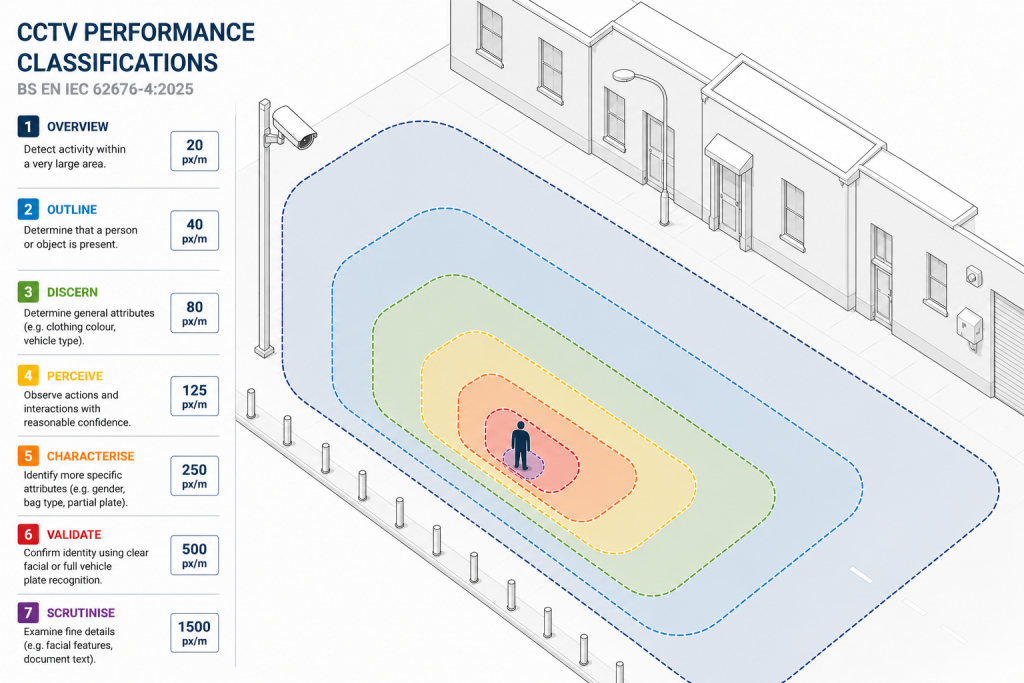
IEC 62676-4:2025 defines seven operational requirement classifications, each representing a different minimum level of image detail required to achieve a specific surveillance objective. Different cameras within the same system will often be designed to different classifications depending on the operational requirements of each location.
Operational Requirement Classifications
| Classification | Minimum Image Density | Typical Purpose | Example Applications |
|---|---|---|---|
| Overview | 20 px/m | Provide general situational awareness and indicate that an object or person is present. | Large open areas, public spaces, site overview, external compounds. |
| Outline | 40 px/m | Show the outline, direction and movement of an object or person. | Perimeter monitoring, boundary fences, vehicle routes, approaches to buildings. |
| Discern | 80 px/m | Distinguish between people, vehicles and other object types. | Car parks, loading bays, warehouse aisles, circulation routes. |
| Perceive | 125 px/m | Observe activities and interactions while understanding what is occurring within the scene. | Reception areas, entrances, customer service areas, shared workspaces. |
| Characterise | 250 px/m | Identify distinguishing characteristics such as clothing, behaviour, vehicle type or other descriptive features. | Secure entrances, access control points, high-value assets, critical infrastructure. |
| Validate | 500 px/m | Verify a known individual or confirm specific information such as a vehicle registration mark or object. | Staff entrances, vehicle gates, ANPR, controlled access points. |
| Scrutinise | 1500 px/m | Provide sufficient detail to establish identity or examine fine detail with a very high level of confidence. | Custody suites, interview rooms, forensic applications, specialist security environments. |
Selecting the Appropriate Performance Level
Every camera should be designed to achieve the operational objective of the location it protects. Specifying the highest classification throughout an entire site is rarely practical or necessary.
For example:
- A perimeter fence may only require Outline.
- A staff car park may require Discern.
- A reception desk may require Perceive.
- A secure access door may require Characterise.
- An ANPR lane may require Validate.
- A custody booking desk may require Scrutinise.
A well-designed CCTV system will typically incorporate multiple performance classifications across the same site, with each camera engineered to achieve its intended operational outcome.
Performance is More Than Pixel Density
Pixel density provides a useful design target, but achieving the required operational outcome depends upon many other factors.
Designers should also consider:
- Lighting conditions
- Scene contrast
- Camera position and viewing angle
- Lens focal length
- Sensor performance
- Motion blur
- Compression settings
- Recording frame rate
- Display resolution
- Environmental conditions such as rain, fog or glare
A camera designed to achieve 250 px/m may still fail to provide the required operational outcome if any of these factors are poorly considered.
Balancing Performance Against Cost
Increasing image performance generally requires narrower fields of view, additional cameras, higher resolution sensors, longer focal length lenses and increased storage and network capacity.
The objective should therefore be to achieve the lowest performance classification that reliably satisfies the operational requirement, rather than maximising image quality throughout the entire system.
Selecting the appropriate classification for each surveillance task allows designers to optimise cost, improve maintainability and deliver systems that are both operationally effective and commercially proportionate.
Camera Selection
Selecting the appropriate camera is about matching the capabilities of the device to the operational requirement. No single camera type is suitable for every application, and most enterprise CCTV systems will utilise a combination of camera technologies to achieve the required operational outcomes.
Location Suitability
| Camera Type | Internal | External | Large Open Areas | Entrances | Perimeter | Roads | Car Parks | Corridors | High Security |
|---|---|---|---|---|---|---|---|---|---|
| Fixed | ●●● | ●●● | ●● | ●●● | ●● | ● | ●● | ●●● | ●●● |
| PTZ | ● | ●●● | ●●● | ● | ●●● | ●●● | ●●● | – | ●● |
| Thermal | – | ●●● | ●●● | ● | ●●● | ●● | ●● | – | ●●● |
| Multi-Sensor | ●● | ●●● | ●●● | ●● | ●● | – | ●●● | ● | ●● |
| Panoramic | ●●● | ●● | ●●● | ●● | ● | – | ●●● | ●●● | ● |
| ANPR | – | ●●● | – | ● | ●● | ●●● | ●●● | – | ● |
Operational Capability
| Camera Type | Situational Awareness | General Surveillance | Active Tracking | Identification | Long Range | Low Light | Wide Coverage | Analytics | Vehicle Recognition |
|---|---|---|---|---|---|---|---|---|---|
| Fixed | ●● | ●●● | – | ●●● | ●● | ●● | ● | ●●● | ● |
| PTZ | ●●● | ●● | ●●● | ●●● | ●●● | ●● | ●●● | ●● | ● |
| Thermal | ●●● | ● | – | – | ●●● | ●●● | ●● | ● | – |
| Multi-Sensor | ●●● | ●●● | – | ●● | ● | ●● | ●●● | ●●● | – |
| Panoramic | ●●● | ●● | – | ● | – | ● | ●●● | ●● | – |
| ANPR | – | – | – | – | ●● | ●●● | – | ● | ●●● |
Advantage & Limitations
| Camera Type | Primary Advantages | Primary Limitations |
|---|---|---|
| Fixed | Lowest cost, predictable coverage, excellent evidential performance. | Limited flexibility once installed. |
| PTZ | Covers large areas, excellent operator control, powerful optical zoom. | Cannot observe multiple directions simultaneously and relies on active operation. |
| Thermal | Exceptional detection in darkness and adverse weather. | Cannot normally provide evidential identification on its own. |
| Multi-Sensor | Wide coverage with fewer mounting locations and infrastructure. | Higher capital cost and more complex configuration. |
| Panoramic | Maximum situational awareness from a single device. | Lower image density across very wide scenes. |
| ANPR | Optimised for reliable vehicle registration capture. | Highly specialised and unsuitable as a general surveillance camera. |
Recording Strategy
The recording strategy determines how, when and where video is stored. It should be selected according to the operational requirements of the system, balancing evidential needs, storage capacity, network utilisation and resilience. Different recording methods may be used across the same system to meet the requirements of different operational areas.
Recording Method Suitability
| Recording Method | High Security | General Surveillance | Low Activity Areas | Remote Sites | Bandwidth Constrained | Evidential Recording | Cloud Deployments |
|---|---|---|---|---|---|---|---|
| Continuous | ●●● | ●●● | ● | ● | ● | ●●● | ● |
| Motion | ● | ●●● | ●●● | ●● | ●●● | ●● | ●● |
| Alarm | ●●● | ● | ●● | ●● | ●● | ●●● | ●● |
| Edge | ●● | ● | ●●● | ●●● | ●●● | ● | ●●● |
Recording Method Capability
| Recording Method | Storage Efficiency | Evidential Completeness | Bandwidth Efficiency | Resilience | Simplicity | Investigation Efficiency |
|---|---|---|---|---|---|---|
| Continuous | ● | ●●● | ● | ●● | ●●● | ●●● |
| Motion | ●●● | ●● | ●●● | ● | ●● | ●● |
| Alarm | ●●● | ●●● | ●●● | ● | ● | ● |
| Edge | ●●● | ● | ●●● | ●●● | ● | ● |
Design Considerations
Retention Periods
Recording retention should be determined by operational requirements, organisational policy and applicable legislation. Longer retention periods increase storage requirements and may influence recording quality or compression settings.
Evidential Requirements
Critical areas requiring complete evidential records may justify continuous recording, whereas lower-risk areas may be adequately served by motion or event-based recording.
Storage Resilience
Consider how recordings will be protected against equipment failures, network outages or malicious activity. RAID storage, redundant recording servers, edge recording and cloud replication can all improve resilience.
Recording Quality
Frame rate, resolution, compression and bitrate should be selected to support the required operational performance. Reducing recording quality to save storage may compromise evidential value.
Bandwidth Implications
Recording architecture has a direct impact on network utilisation. Continuous recording generates predictable but higher traffic, while motion and event-based recording can significantly reduce bandwidth requirements.
Operational Trade-offs
No recording strategy is suitable for every application. Most enterprise CCTV systems combine multiple recording methods to balance evidence quality, storage efficiency, resilience and operational cost. The appropriate strategy should always support the operational requirements of the protected area rather than simply minimising storage consumption.
CCTV System Storage Architecture
The storage architecture determines where recorded video is retained and how it is protected throughout its retention period. The chosen solution should provide sufficient performance, resilience and scalability to meet operational and evidential requirements while supporting future expansion.
Storage Type Suitability
| Storage Option | Small Systems | Enterprise Systems | High Availability | Scalability | Performance | Cost Efficiency | Multi-Site |
|---|---|---|---|---|---|---|---|
| Direct Attached Storage (DAS) | ●●● | ● | ● | ● | ●●● | ●●● | – |
| RAID Storage | ●●● | ●●● | ●●● | ●● | ●●● | ●● | ● |
| Network Attached Storage (NAS) | ●● | ●● | ●● | ●●● | ●● | ●● | ●● |
| Storage Area Network (SAN) | ● | ●●● | ●●● | ●●● | ●●● | ● | ●● |
| Server-Based Storage | ●● | ●●● | ●● | ●●● | ●●● | ●● | ●● |
| Cloud Storage | ● | ●● | ●● | ●●● | ● | ● | ●●● |
| Hybrid Storage | ● | ●●● | ●●● | ●●● | ●●● | ●● | ●●● |
Design Considerations
Capacity Planning
Storage capacity should be calculated using camera quantity, bitrate, resolution, frame rate, recording method and required retention period. Future expansion should also be considered to avoid premature storage upgrades.
Performance
The storage solution must be capable of sustaining continuous write operations from all recording cameras while supporting simultaneous playback, export and investigation activities. High camera counts or high-resolution systems may require higher-performance storage architectures.
Scalability
The storage architecture should accommodate future increases in camera numbers, image quality and retention requirements without requiring complete replacement of the existing infrastructure.
Redundancy
Critical systems should be designed to minimise data loss resulting from hardware failures. RAID configurations, redundant storage arrays and replicated storage can significantly improve system availability and evidential protection.
Recovery
Designers should consider how recorded footage will be recovered following hardware failure, accidental deletion or cyber incidents. Backup strategies, replication and disaster recovery procedures may all form part of the overall storage strategy.
Operational Resilience
The storage architecture should continue supporting operational requirements during component failures, maintenance activities and system upgrades. The level of resilience should be proportionate to the operational importance of the CCTV system.
Best Practice
- Calculate storage requirements using the expected recording profile, not manufacturer estimates.
- Allow additional capacity for future expansion.
- Select RAID levels appropriate to the operational risk.
- Consider separate storage for archive footage where long retention periods are required.
- Balance performance, resilience and cost rather than maximising storage capacity alone
CCTV System Network Architecture
The network forms the backbone of every modern IP CCTV system. A well-designed network should provide sufficient capacity, resilience and security to support current operational requirements while allowing for future expansion. Network design should be considered from the earliest stages of a project rather than as an afterthought.
Design Considerations
Bandwidth
Network bandwidth should be calculated using the expected bitrate of every connected device, taking into account recording quality, frame rate, compression, multicast streams and future expansion. Both average and peak utilisation should be considered when sizing links.
Latency
Most CCTV systems are tolerant of moderate network latency, but excessive delay can affect live viewing, PTZ control, alarm response and video analytics. Where low-latency operation is required, network architecture should minimise unnecessary routing and congestion.
Power over Ethernet (PoE)
PoE simplifies installation by delivering both power and data over a single Ethernet cable. Designers should verify both the available power budget and the power requirements of connected devices, particularly PTZ cameras, IR illuminators, heaters and multi-sensor cameras.
Multicast
Multicast can significantly reduce network utilisation where multiple users require simultaneous access to the same live video stream. Not all networks or devices support multicast, and its use should be coordinated with the wider IT infrastructure.
Virtual LANs (VLANs)
Separating CCTV devices onto dedicated VLANs improves network security, simplifies management and reduces unnecessary broadcast traffic. Larger or more complex systems may utilise separate VLANs for cameras, servers, workstations and management traffic.
Network Resilience
Critical CCTV systems should be designed to minimise single points of failure. Depending on the operational requirements, resilience may be achieved through redundant switches, dual uplinks, fibre ring topologies, multiple network paths or resilient core infrastructure.
Uplink Capacity
Switch uplinks should be sized to accommodate the combined traffic generated by connected cameras, client workstations and recording servers. Oversubscribed uplinks can result in congestion, increased latency and reduced system performance.
Scalability
The network should be designed with sufficient spare capacity to accommodate future cameras, recording servers, workstations and additional security systems. Expansion should not require fundamental changes to the underlying network architecture.
Best Practice
- Calculate bandwidth before selecting network hardware.
- Select switches with adequate PoE budgets and uplink capacity.
- Separate CCTV traffic using dedicated VLANs where appropriate.
- Design resilience according to the operational risk.
- Allow spare switch ports, fibre capacity and bandwidth for future expansion.
- Coordinate network design with the client’s IT team from the outset.
CCTV System Resilience
Resilience is the ability of a CCTV system to continue supporting its operational requirements following equipment failures, power outages, network disruption or other unforeseen events. The level of resilience should be proportionate to the operational importance of the system and the consequences of failure.
Resilience Measure Suitability
| Resilience Measure | Small Systems | Enterprise Systems | Critical Infrastructure | Multi-Site | High Availability |
|---|---|---|---|---|---|
| UPS Protection | ●● | ●●● | ●●● | ●● | ●●● |
| Dual Recording | – | ●● | ●●● | ●● | ●●● |
| Server Redundancy | – | ●● | ●●● | ●● | ●●● |
| Automatic Failover | – | ●● | ●●● | ●● | ●●● |
| Redundant Switching | ● | ●● | ●●● | ●● | ●●● |
| Dual Fibre Paths | – | ●● | ●●● | ●●● | ●●● |
| Edge / SD Card Recording | ● | ●● | ●●● | ●●● | ●● |
Artificial Intelligence & Analytics
Artificial intelligence and video analytics can significantly improve the operational effectiveness of a CCTV system when applied to appropriate use cases. They should be selected to support clearly defined operational requirements rather than simply because they are available. Successful deployments require careful consideration of environmental conditions, operational processes and expected system performance.
Analytics Suitability
| Analytics Type | Perimeter Protection | Building Security | People Counting | Traffic Management | Forensic Search | Remote Monitoring |
|---|---|---|---|---|---|---|
| Motion Detection | ●● | ●● | – | – | – | ●● |
| Line Crossing | ●●● | ●●● | ● | ●● | ● | ●●● |
| Intrusion Detection | ●●● | ●●● | – | ● | ● | ●●● |
| Object Detection | ●● | ●● | ● | ●● | ●● | ●● |
| Loitering Detection | ●●● | ●● | ● | – | ● | ●●● |
| Face Detection | ● | ●● | – | – | ●●● | ● |
| License Plate Recognition | – | ● | – | ●●● | ●●● | ● |
| AI Metadata Search | ●● | ●● | ●● | ●● | ●●● | ●● |
This is not intended to be an exhaustive list of analytic types or scenarios, but to indicate that some analytic types are more strongly suited to different applications
Edge vs. Server Analytics
| Capability | Edge Analytics | Server Analytics |
|---|---|---|
| Real-time response | ●●● | ●● |
| Scalability | ●● | ●●● |
| Advanced AI models | ● | ●●● |
| Bandwidth efficiency | ●●● | ● |
| Centralised management | ● | ●●● |
| Hardware requirements | ●●● | ● |
Design Considerations
Operational Suitability
Analytics should support a clearly defined operational requirement, such as perimeter protection, occupancy monitoring or vehicle management. The chosen analytic should be capable of delivering measurable operational value.
Environmental Conditions
Lighting, weather, scene complexity, camera angle and target behaviour all influence analytic performance. Systems should be designed to minimise environmental factors that reduce detection accuracy.
False Positives and False Negatives
No analytic is perfectly accurate. Designers should understand the operational impact of missed detections and nuisance alarms and configure systems to achieve an appropriate balance between sensitivity and reliability.
Metadata
Modern analytics generate searchable metadata describing people, vehicles and events. This can significantly reduce investigation times by allowing operators to search recorded video using attributes rather than manually reviewing footage.
AI-Assisted Investigation
AI can assist operators by rapidly locating people, vehicles or objects within large video datasets. These capabilities improve operational efficiency but should support, rather than replace, human decision-making.
Validation
Analytics should be tested under representative operating conditions to confirm they achieve the required operational outcomes before the system is accepted into service
Lifecycle Considerations
A CCTV system should be designed to remain effective throughout its operational life, not simply at the point of commissioning. Anticipating future growth, technology changes and evolving operational requirements can significantly reduce the cost and complexity of future upgrades.
Design Considerations
Future Expansion
The system should be designed with sufficient capacity to accommodate additional cameras, recording servers, storage and client workstations without requiring major architectural changes.
Technology Refresh
Hardware and software components will reach end of support at different times. Selecting open, standards-based technologies can simplify future replacement and reduce vendor lock-in.
Capacity Growth
Storage, network bandwidth, server performance and licensing should all include reasonable allowances for future operational growth rather than being designed only for current requirements.
Software & Firmware Lifecycle
Manufacturers regularly release firmware and software updates to introduce new functionality, improve performance and address security vulnerabilities. Designers should ensure the system can be maintained without unnecessary operational disruption.
Operational Change
The operational requirements of a site are likely to evolve over time. The CCTV system should be sufficiently flexible to accommodate changes in building use, security policies, organisational structure and operational priorities.
Integration Readiness
Future integration with access control, intrusion detection, intercom, PSIM, building management systems or emerging technologies should be considered where appropriate, even if these systems are not included within the initial project scope.
Documentation
Accurate design documentation, configuration records, network information and as-built drawings simplify future maintenance, fault diagnosis and system expansion throughout the operational life of the installation.
Whole-Life Cost
Design decisions should consider the total cost of ownership rather than initial capital expenditure alone. Maintenance, licensing, energy consumption, component replacement and future upgrades all contribute to the overall value of the system.
Best Practice
- Design for future expansion rather than current capacity.
- Use open standards wherever practical.
- Avoid unnecessary vendor lock-in.
- Produce comprehensive as-built documentation.
- Consider total cost of ownership throughout the expected operational life of the system.
For guidance on managing CCTV systems throughout their operational life, see Security Design Process – Lifecycle Management