
Procuring a security system is about far more than obtaining competitive quotations. The decisions made during procurement determine not only the cost of the project, but also the quality, performance and long-term effectiveness of the completed solution.
Successful procurement begins long before a tender is issued. Organisations must first understand their operational objectives, assess the risks they are seeking to address and develop a robust security design that clearly defines what the system is expected to achieve. Only then can contractors prepare accurate and comparable proposals based upon a common understanding of the project requirements.
This guide explains the procurement process for electronic security projects, from establishing the initial need through to contractor selection, project delivery, acceptance and long-term lifecycle management. Rather than replacing the Security Design Process, it demonstrates how the two methodologies work together to deliver successful security projects.
Throughout this guide, references are made to the Security Design Process, which provides the detailed methodology for developing operational requirements, assessing risks, defining system performance, designing the solution, validating the completed installation and managing the system throughout its operational life. Together, these two guides provide a structured framework for procuring, delivering and maintaining effective security solutions.
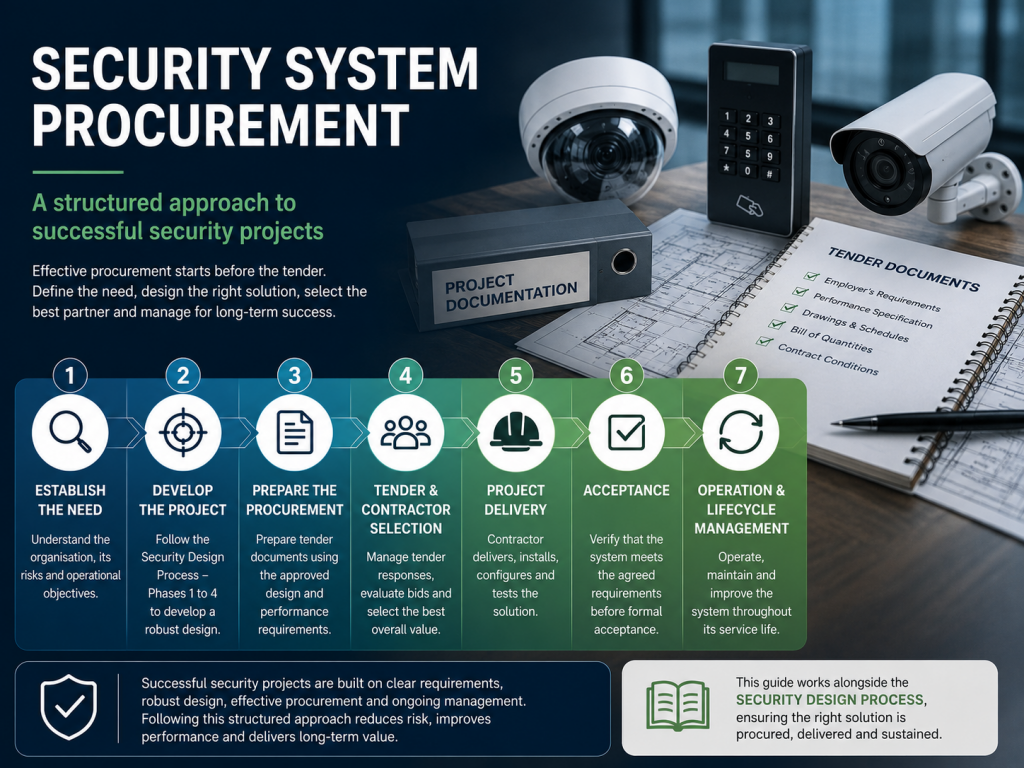
1. Establish the Need
Every successful security project begins with a clearly defined business need. Organisations often begin by discussing technology or requesting quotations, but these activities should only take place once the reason for the project has been properly understood.
At this stage, the objective is to establish why the project is required, who will own it and how decisions will be made throughout its lifecycle. The organisation should identify the business drivers, secure executive support and determine whether it possesses sufficient internal expertise to develop the project independently.
Many organisations have experienced facilities, estates or procurement teams, but relatively few undertake complex security projects frequently enough to maintain specialist design expertise. Appointing an independent security consultant or suitably qualified security designer at an early stage can significantly reduce project risk by ensuring that subsequent decisions are based upon operational requirements rather than assumptions or product preferences.
Objectives
- Define the business problem that the project is intended to address.
- Identify the project sponsor and key stakeholders.
- Establish governance and decision-making responsibilities.
- Confirm the available budget and funding approach.
- Determine whether external specialist security expertise is required.
Typical Activities
- Identify the operational drivers for the project.
- Review previous incidents, audits or business concerns.
- Define the initial project scope.
- Identify key internal stakeholders and decision makers.
- Appoint a project sponsor.
- Establish an indicative budget and programme.
- Determine whether to appoint an independent security consultant or security designer.
Recommended Action
Where the organisation does not possess specialist security design expertise, an independent security consultant or suitably qualified security designer should be appointed before any significant procurement activity begins. Their role is to represent the client’s interests, develop the operational requirements, manage the design process and ensure that any subsequent procurement is based upon objective performance requirements rather than supplier-led solutions.
Next Step
Once the project has been established and the appropriate expertise appointed, the organisation should begin Security Design Process – Phase 1: Understand.
During this phase, the consultant should work closely with stakeholders to develop the Business Objectives, Stakeholder Requirements, Operational Requirements, Critical Assets, and Constraints & Assumptions that will form the foundation of the entire project. These outputs should be reviewed and approved by the client before progressing to the next stage of procurement.
2. Develop the Project
With the project established and the appropriate expertise appointed, the consultant or security designer should now lead the development of the project through the first four phases of the Security Design Process.
These phases progressively develop the project from an initial business need into a complete security design that can be confidently procured. At the end of each phase, the client should review the documentation, confirm that it accurately reflects the organisation’s requirements and formally approve the outputs before authorising work to continue.
Taking a staged approval approach reduces project risk, ensures stakeholder agreement and prevents expensive design changes later in the procurement process.
Security Design Process – Phase 1: Understand
The first phase establishes the operational foundation of the project. Rather than discussing technology, the consultant should work with stakeholders to understand what the organisation is trying to achieve, what assets require protection and what constraints will influence the design.
Before progressing, the client should review and approve:
- Business Objectives
- Stakeholder Register
- Operational Requirements
- Critical Assets
- Constraints & Assumptions
These documents should accurately represent the organisation’s operational needs and establish the scope for the remainder of the project. Any misunderstandings at this stage are likely to affect every subsequent phase.
Security Design Process – Phase 2: Assess
Once the operational requirements have been agreed, the consultant should assess the risks facing the organisation. This phase determines which threats are relevant, identifies vulnerabilities and evaluates the risks that the proposed security solution will be expected to manage.
Before progressing, the client should review and approve:
- Threat Assessment
- Vulnerability Assessment
- Risk Register
- Risk Prioritisation
- Residual Risk Assessment
Together, these documents provide the business justification for the project, demonstrating why investment is necessary and which risks the proposed security measures are intended to reduce.
Security Design Process – Phase 3: Define
Having established the operational requirements and understood the risks, the consultant should define exactly what the security solution must achieve. This phase produces measurable performance requirements without specifying particular manufacturers or technologies unless there is a justified operational reason for doing so.
Before progressing, the client should review and approve:
- Performance Requirements
- Functional Requirements
- Non-functional Requirements
- Acceptance Criteria
- Success Measures
These documents define what constitutes a successful project and provide the objective criteria against which the completed system will ultimately be tested and accepted.
Security Design Process – Phase 4: Design
The final design phase converts the approved requirements into a complete technical solution. The consultant should develop the security architecture, produce the engineering documentation and prepare all information necessary for contractors to understand the scope of work and provide accurate tenders.
Before progressing, the client should review and approve:
- High Level Design
- Low Level Design (where appropriate)
- Performance Specification
- Drawings and Schematics
- Equipment Schedules
- Integration Strategy
- Engineering Documentation
At this stage, the project design should be sufficiently complete for competent contractors to price accurately, with minimal ambiguity or reliance on assumptions. Any remaining design uncertainty is likely to result in inconsistent tenders, increased project risk and additional costs during delivery.
3. Prepare the Procurement
Once the security design has been reviewed and approved, the project can move into procurement. The objective of this stage is to convert the approved design into a clear and comprehensive tender package that enables competent contractors to prepare accurate, consistent and comparable submissions.
A well-prepared procurement package reduces ambiguity, encourages fair competition and significantly reduces the likelihood of scope changes, contractual disputes and unexpected costs during project delivery. Every contractor should be pricing the same project against the same documented requirements.
The procurement documentation should describe what is required, how tenders will be evaluated and what the successful contractor will ultimately be expected to deliver.
Procurement Documentation
The exact documentation will vary depending on the size, complexity and procurement route of the project, but a typical security procurement package should include the following.
Invitation to Tender (ITT)
The Invitation to Tender provides contractors with the overall procurement instructions, submission requirements, programme, evaluation process and administrative information required to participate in the tender.
Employer’s Requirements
The Employer’s Requirements define the client’s expectations, project scope, standards, deliverables and contractual obligations. This document should reference the approved security design rather than introduce new technical requirements.
Performance Specification
The Performance Specification should describe the operational outcomes and measurable performance criteria that the completed security solution must achieve. It should avoid unnecessary prescription wherever possible, allowing competent contractors to propose appropriate technical solutions.
Pricing Schedule or Bill of Quantities
A structured pricing schedule enables all contractors to price the project on a consistent basis, making tender submissions easier to compare and reducing the risk of omitted items or hidden costs.
Tender Evaluation Matrix
The evaluation matrix should establish how tenders will be assessed before submissions are received. Typical evaluation criteria may include technical compliance, project methodology, relevant experience, programme, commercial value, lifecycle costs and social value where appropriate.
Contract Conditions
The procurement package should clearly identify the contractual arrangements that will govern delivery of the project, including responsibilities, payment mechanisms, warranties, liabilities and change management procedures.
Programme Requirements
Contractors should understand the expected project programme, including key milestones, access restrictions, operational constraints, commissioning activities and required completion dates.
Handover Requirements
The tender documentation should define the information, documentation and training that the successful contractor will be required to provide before practical completion and final acceptance. This should include testing records, drawings, operation and maintenance information, user training and asset information where applicable.
Role of the Security Consultant
The security consultant or security designer will typically support the client in preparing the procurement documentation, ensuring that it accurately reflects the approved design and provides sufficient information for contractors to prepare robust and comparable tenders. They may also advise on the procurement strategy, recommended contractor shortlist, evaluation methodology and technical queries raised during the tender period.
By the end of this stage, the project should have a complete procurement package that can be issued to the selected contractors with confidence that each bidder is pricing the same defined scope of work.
4. Tender & Contractor Selection
With the procurement documentation complete, the project can be issued to the selected contractors for tender. The objective of this stage is to identify the organisation best able to deliver the approved design, rather than simply selecting the lowest-priced submission.
A robust tender process should provide all bidders with the same information, sufficient time to prepare their submissions and a fair opportunity to seek clarification where necessary. All tenders should be evaluated against the pre-defined evaluation criteria established during the procurement preparation stage.
The consultant should normally act as the client’s technical advisor throughout the tender process, ensuring that submissions are evaluated consistently, technical risks are identified and recommendations are based upon objective evidence.
Tender Management
During the tender period, the consultant will typically support the client by managing the technical aspects of the procurement process, including:
- responding to tender clarifications;
- answering technical queries from bidders;
- issuing amendments or additional information where required;
- ensuring all bidders receive consistent information;
- reviewing proposed alternatives or value engineering suggestions.
Tender Evaluation
Once submissions have been received, each tender should be reviewed against the published evaluation criteria. The objective is to identify the submission that offers the greatest overall value whilst demonstrating full compliance with the project requirements.
The consultant will typically undertake or support:
- technical compliance reviews;
- commercial and pricing comparisons;
- evaluation against the tender scoring matrix;
- assessment of proposed equipment and technical solutions;
- review of contractor competence, experience and project methodology;
- identification of qualifications, exclusions and commercial risks.
Interviews and Demonstrations
For larger or higher-risk projects, shortlisted contractors may be invited to attend interviews, technical presentations or product demonstrations. These sessions provide an opportunity to validate the contractor’s understanding of the project, assess the proposed delivery team and clarify any outstanding technical or commercial matters before a final decision is made.
Recommendation Report
Following completion of the evaluation, the consultant should prepare a recommendation report summarising the tender process, evaluation results, technical observations and overall recommendation. This report should clearly explain how the preferred contractor satisfies the project requirements and identify any residual risks or qualifications that should be considered before contract award.
Client Decision
The final appointment should always remain the responsibility of the client. Whilst cost is an important consideration, contractor selection should balance technical competence, relevant experience, quality of the proposed solution, delivery capability, lifecycle value and commercial performance. Selecting the lowest-priced tender without considering these factors can introduce significant delivery and operational risks that outweigh any initial cost savings.
By the end of this stage, the preferred contractor should have been identified and the client should be in a position to proceed with contract award and project mobilisation.
5. Post Procurement Project Delivery
Following contract award, responsibility for delivering the project transfers to the appointed contractor. This typically includes procurement of equipment, production of installation documentation, system installation, configuration, commissioning, training and preparation of the handover documentation.
Throughout project delivery, the client should ensure that appropriate governance arrangements remain in place. Where an independent security consultant has been appointed, they will typically continue to provide technical oversight, review proposed design changes, attend key project meetings and verify that the delivered solution remains aligned with the approved design intent.
Effective management of security projects extends beyond procurement and includes programme management, design reviews, change control, commissioning management and contractor coordination.
Once the contractor has completed installation and commissioning, the project should move into formal testing and acceptance before being placed into operational service.
6. Acceptance
Completion of the installation does not necessarily mean the project is complete. Before the system is accepted into operational service, the client should ensure that it has been independently tested, validated and demonstrated to satisfy the requirements established during the earlier phases of the Security Design Process.
At this stage, the procurement process returns to the Security Design Process – Phase 5: Assure, where the completed solution is formally assessed against the agreed operational, functional and performance requirements. Acceptance should be based upon objective evidence rather than confirmation that the equipment has simply been installed.
Acceptance Activities
The security consultant will typically witness, review or coordinate the following acceptance activities, as appropriate to the size and complexity of the project:
- Factory Acceptance Testing (FAT), where applicable;
- Site Acceptance Testing (SAT);
- Operational Validation;
- User Acceptance Testing (UAT);
- review of the handover documentation.
Acceptance Criteria
The completed system should only be accepted once the agreed acceptance criteria have been satisfied and the client is confident that the solution delivers the operational outcomes defined at the start of the project. Any outstanding defects, deviations or incomplete works should be recorded and managed through an agreed process before final acceptance is granted.
Detailed guidance on Factory Acceptance Testing, Site Acceptance Testing, Operational Validation, User Acceptance and Handover Documentation is provided within Security Design Process – Phase 5: Assure.
7. Beyond Procurement: Operation & Lifecycle Management
Formal acceptance marks the end of the procurement project, but it is not the end of the security system’s lifecycle. Responsibility for the solution now transfers fully to the organisation, which must ensure that it continues to operate, perform and evolve throughout its operational life.
Many organisations invest considerable time and resources in procuring a new security system, only to place limited focus on its long-term management. Without effective governance, systems can gradually become less reliable, less secure and less capable of supporting the operational requirements they were originally designed to achieve.
Once the project has been completed, organisations should continue with Security Design Process – Phase 6: Lifecycle Management, adopting a structured approach to maintenance, performance monitoring, technology refresh and continual improvement.
Ownership Responsibilities
Following handover, the organisation should ensure that clear ownership arrangements are established for the ongoing management of the security system. This may include facilities management, security management, estates, IT, operational teams or specialist service providers, depending on the complexity of the solution.
Responsibilities should typically include:
- Managing maintenance contracts and service providers.
- Monitoring system performance and operational effectiveness.
- Maintaining accurate asset registers and technical documentation.
- Applying software, firmware and cyber security updates.
- Managing system users, permissions and access controls.
- Reviewing alarms, incidents and system usage to identify trends and opportunities for improvement.
- Controlling and documenting system changes to ensure the original design intent is maintained.
- Planning equipment replacement, technology refresh and future expansion.
- Ensuring operators, administrators and maintenance personnel remain appropriately trained.
- Periodically reviewing whether the system continues to meet the organisation’s operational requirements.
The Role of the Security Consultant
Although the consultant’s formal appointment often concludes at project completion, many organisations choose to retain independent specialist support through periodic technical reviews, security audits or strategic advisory services. Independent reviews can provide assurance that the system continues to satisfy operational requirements, remains aligned with current risks and continues to represent good value throughout its operational life.
A consultant may also be re-engaged when significant changes are proposed, such as estate expansion, major refurbishment projects, integration with additional systems or replacement of key technologies. Their independent perspective can help ensure that changes are properly assessed before implementation and that the original design principles are maintained.
Continuous Improvement
Security systems should not be regarded as static assets. Organisational priorities, operational processes, technologies and threat environments all change over time. Periodic review enables organisations to identify emerging risks, improve system performance and plan future investment before equipment reaches the end of its operational life.
Rather than waiting for equipment to fail or become obsolete, organisations should adopt a planned lifecycle approach that includes preventive maintenance, scheduled performance reviews, controlled change management and technology refresh programmes. This approach reduces operational risk, improves resilience and maximises the value obtained from the original investment.
Equally important is ensuring that the system continues to deliver the operational outcomes that justified the original investment. Changes to the organisation, its people, its sites or its risks may require operational requirements to be revisited, with subsequent changes to the security design to maintain effectiveness.
Further Guidance
Detailed guidance on managing security systems throughout their operational life is provided within Security Design Process – Phase 6: Lifecycle Management, which covers preventive maintenance, performance reviews, technology refresh, change management and continuous improvement in greater detail.
As organisations evolve, the Security Design Process should be viewed as a continuous cycle rather than a one-off project methodology. Periodically revisiting the operational requirements, reassessing risks and validating system performance helps ensure that security solutions continue to support the organisation’s objectives throughout their service life.