
A modern intercom system provides far more than simple visitor communication. They support identity verification, remote door release, emergency communication and integration with wider security systems. The chosen architecture should reflect the operational requirements, scale of the installation and required level of resilience.
Intercom System Architecture
The selected architecture determines how calls are initiated, routed and managed, how endpoints communicate, how doors are controlled and how the system integrates with other security platforms. Different architectures provide varying levels of functionality, scalability, resilience and operational flexibility.
Architecture Types
Analogue
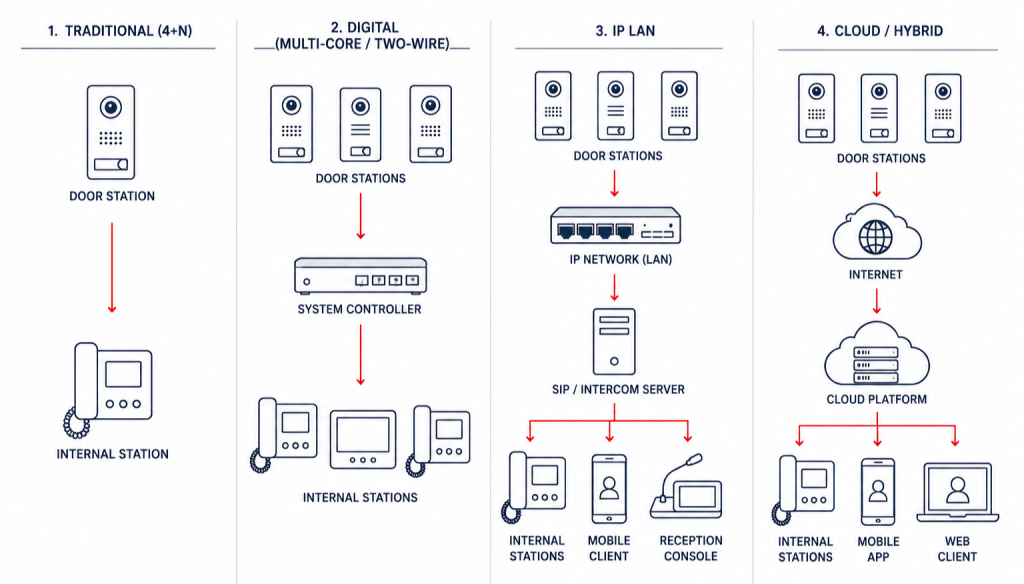
Traditional analogue intercom systems utilise dedicated wiring between the door station and each internal station, with separate conductors carrying power, audio, call signalling and door release functions. Although largely superseded by digital and IP systems, they remain suitable for simple installations where only basic functionality is required.
Digital Multi-Core
Digital multi-core systems reduce the number of conductors required by transmitting digital communications over a shared, usually 4 or 5 wire, multicore cable. They provide greater flexibility than traditional analogue systems while retaining a dedicated wired infrastructure and supporting larger installations.
Digital Two-Wire
Two-wire digital systems transmit power, audio, video and signalling over a single pair of conductors. They are commonly used when upgrading existing analogue installations, allowing modern functionality to be introduced while reusing existing building cabling.
IP LAN
IP-based intercom systems utilise an Ethernet network to connect door stations, internal stations and management software. They support advanced call routing, remote management, SIP integration, high-definition video and integration with wider security systems, making them suitable for both small and enterprise deployments.
Cloud Managed IP
Cloud managed systems utilise IP-connected intercom devices administered through a cloud-based management platform. They simplify deployment across multiple sites, support remote administration and reduce the requirement for dedicated on-premises management infrastructure.
Hybrid
Hybrid systems combine two or more communication technologies within the same installation, such as IP networking with two-wire or analogue infrastructure. This approach is commonly used during phased upgrades or when integrating new systems into existing buildings without replacing all field wiring
Typical Applications
| Architecture | Typical Applications |
|---|---|
| Analogue | Individual dwellings, small residential buildings, simple commercial entrances and legacy installations. |
| Digital Multi-Core | Apartment buildings, schools, commercial offices and medium-sized buildings requiring dedicated cabling. |
| Digital Two-Wire | Refurbishment projects, residential developments and building upgrades where existing cabling is retained. |
| IP LAN | Commercial offices, hospitals, education, industrial facilities, multi-building campuses and enterprise estates. |
| Cloud Managed IP | Multi-site organisations, retail, distributed businesses, managed properties and organisations requiring remote administration. |
| Hybrid | Building refurbishments, phased migrations, campus environments and organisations integrating legacy and modern systems. |
Advantages & Disadvantages
| Architecture | Typical Deployment Size | Endpoint Options | Call Routing Capability | Remote Answering | Mobile Support | Video Capability | Integration Capability | Scalability | Installation Complexity | Typical Limitations |
|---|---|---|---|---|---|---|---|---|---|---|
| Analogue | Single entrance to small buildings | Audio, basic video handsets | Single destination | – | – | ● | – | ● | Low | Dedicated wiring, limited functionality, difficult expansion and little or no integration. |
| Digital Multi-Core | Small to medium installations | Audio & video stations, internal monitors | Basic to moderate | ● | – | ●● | ● | ●● | Medium | Manufacturer-specific infrastructure, limited interoperability and expansion compared with IP. |
| Digital Two-Wire | Small to medium installations and refurbishments | Audio & video stations, internal monitors | Moderate | ● | ● | ●● | ● | ●● | Low–Medium | Dependent on proprietary technologies, limited bandwidth and fewer enterprise features. |
| IP LAN | Small to enterprise deployments | Audio, video, SIP endpoints, desktop clients, mobile apps | Advanced | ●●● | ●●● | ●●● | ●●● | ●●● | Medium–High | Requires network infrastructure, greater configuration complexity and IT involvement. |
| Cloud Managed IP | Multi-site and distributed organisations | IP endpoints, web clients, mobile apps | Advanced | ●●● | ●●● | ●●● | ●● | ●●● | Low | Internet dependency, subscription licensing and reduced control over hosting. |
| Hybrid | Existing estates undergoing migration | Mixed analogue, digital and IP endpoints | Advanced | ●●● | ●●● | ●●● | ●●● | ●●● | High | Mixed technologies increase commissioning, administration and long-term support complexity. |
Failure Modes
Each architecture responds differently to equipment, network and power failures. Traditional analogue and digital wired systems are largely independent of IP networks, whereas IP and cloud-managed systems rely on network infrastructure for communications and management. Designers should consider how calls are handled during network outages, whether local communication remains available and the operational impact of losing remote management or integration services.
Whole-Life Cost
The initial installation cost represents only part of the total cost of ownership. Designers should consider future expansion, software licensing, endpoint replacement, firmware updates, maintenance, integration requirements and technology refresh when selecting an architecture. The most appropriate solution is one that delivers the required operational capability while providing the best long-term value over the expected life of the system.
Integration
Modern intercom systems are increasingly integrated with wider security and building systems rather than operating independently. Integration requirements should be identified early within the design process to ensure compatibility between platforms and support future operational requirements.
| Integration | Typical Purpose | Benefits | Design Considerations |
|---|---|---|---|
| Access Control | Identity verification and remote door release. | Unified visitor management, improved security and simplified administration. | Compatibility with controllers, door release logic, permissions and event logging. |
| CCTV | Associate video with intercom calls and door events. | Visual verification, improved situational awareness and evidential recording. | Camera positioning, event synchronisation and recording requirements. |
| Video Management Systems (VMS) | Display intercom video alongside CCTV within a common operator interface. | Single operational platform, simplified monitoring and incident investigation. | ONVIF Profile support, RTSP streams, event integration and operator workflows. |
| SIP / VoIP Platforms | Route calls through the corporate telephone system. | Flexible call routing, remote answering and reduced dedicated hardware. | SIP compatibility, licensing, network quality and resilience. |
| Public Address & Voice Alarm (PA/VA) | Emergency announcements and incident response. | Coordinated communications during emergencies. | Audio routing, priorities and compliance with emergency procedures. |
| Lift Communication | Emergency communication between lift cars and control points. | Improves passenger safety and supports emergency response. | Compliance with lift regulations, resilience and emergency power requirements. |
| Vehicle Gates & Barriers | Visitor communication and controlled vehicle access. | Centralised management of pedestrian and vehicle access. | Integration with gate controllers, ANPR and safety systems. |
| Building Management Systems (BMS) | Exchange operational status and events. | Improved monitoring and coordinated building operation. | Interface compatibility and operational requirements. |
| Remote Monitoring | Calls and alarms monitored by security control rooms or third-party monitoring centres. | Centralised response, reduced staffing requirements and improved resilience. | Secure communications, network resilience and escalation procedures. |
System Resilience
Intercom systems should continue supporting critical communication, visitor management and emergency functions during equipment failures, power interruptions and network outages. The required level of resilience should be determined by the operational importance of the system and the consequences of communication being unavailable.
Design Considerations
Local Operation
Where practical, intercom systems should continue supporting local communication and door release functions even if connection to a central management platform or cloud service is temporarily unavailable.
Power Resilience
Critical components, including door stations, controllers, network switches and management servers, should be protected against power interruptions where continued operation is required. Battery backup or UPS systems may be appropriate for business-critical or life safety applications.
Network Resilience
IP-based intercom systems rely upon the availability of the underlying network infrastructure. Designers should consider the resilience of network switches, uplinks and communications paths, particularly where the system supports critical operations or multiple buildings.
Cloud & Internet Connectivity
Cloud managed systems should be assessed to determine the operational impact of losing Internet connectivity. While local communication and door control may continue, remote administration, mobile applications and cloud-based services may become temporarily unavailable.
Video Streaming
Where intercom video is integrated with a Video Management System (VMS) using ONVIF or RTSP, designers should consider the impact of network congestion, recording failures and stream availability. If recorded intercom video forms part of the operational requirement, appropriate recording resilience should also be considered.
SIP & Communications Services
Where SIP or VoIP platforms are used, designers should consider the resilience of the telephony infrastructure, including SIP servers, call routing services and network availability. Failure of these services may prevent calls from reaching internal stations or mobile users.
Emergency Communications
Systems used for emergency help points, lift communication or other safety-critical applications should be designed with an appropriate level of redundancy and fault monitoring to ensure communication remains available when required.
Business Continuity
The level of resilience should be proportionate to the operational consequences of failure. Critical sites may justify redundant network infrastructure, resilient servers or backup communication paths, whereas simpler installations may accept a temporary loss of functionality during equipment failures.
Best Practice
- Design resilience in proportion to the operational risk.
- Ensure local communication and door control remain available wherever practical.
- Protect critical components against power loss.
- Consider the impact of network and Internet outages.
- Evaluate the resilience of SIP and cloud services where used.
- Verify resilience requirements during commissioning and acceptance testing.
Lifecycle Considerations
An intercom system should be designed to remain reliable, maintainable and compatible with evolving communication technologies throughout its operational life. Considering future expansion, software updates and changing operational requirements during the design stage can reduce disruption and minimise the cost of future upgrades.
Design Considerations
Future Expansion
The system should be capable of accommodating additional door stations, internal stations, buildings and users without requiring significant changes to the underlying architecture. Sufficient capacity should be considered for endpoints, software licensing and network infrastructure.
Endpoint Replacement
Door stations, internal stations and communication devices will inevitably require replacement during the life of the system. Selecting architectures that support backwards compatibility or phased replacement can reduce future costs and operational disruption.
SIP & Communications Standards
Where SIP-based communications are utilised, designers should consider compatibility with future telephony platforms, unified communications systems and emerging technologies. Standards-based solutions can reduce vendor lock-in and simplify future integration.
Software & Firmware Lifecycle
Management software, firmware and mobile applications should be maintained throughout the operational life of the system to introduce new functionality, improve reliability and address cyber security vulnerabilities. Designers should consider how updates will be managed with minimal impact on system availability.
Documentation
Accurate as-built drawings, endpoint schedules, network information, configuration records and user documentation simplify maintenance, fault diagnosis and future expansion.
Future Integration
Future integration with access control, CCTV, Video Management Systems (VMS), SIP platforms, public address systems and building management systems should be considered during the initial design, even where these systems are not included within the current project scope.
Whole-Life Cost
The total cost of ownership extends beyond the initial installation and includes software licensing, hardware replacement, maintenance, technical support, firmware updates and future expansion. Design decisions should balance operational capability with long-term value rather than initial purchase price alone.
Best Practice
- Design for future expansion rather than current requirements.
- Select standards-based technologies wherever practical.
- Maintain comprehensive system documentation.
- Consider future integration during the initial design.
- Evaluate whole-life cost rather than initial capital expenditure.
- Periodically review the system to ensure it continues to meet operational requirements and technological expectations.
For guidance on managing Intercom Systems throughout their operational life, see Security Design Process – Lifecycle Management