
A perimeter intrusion detection system (PIDS) provides early warning of attempted or actual unauthorised access before an intruder reaches the protected asset. Effective perimeter protection relies upon selecting the appropriate detection technologies, positioning them correctly and integrating them with CCTV, access control and response procedures to support defined operational outcomes.
The detection strategy should be determined by the type of perimeter, the operational requirement and the available response time. Different perimeter designs require different sensing technologies, and many sites benefit from combining multiple detection methods to improve reliability and reduce nuisance alarms.
Detection Technologies
| Detection Technology | Typical Applications | Advantages | Disadvantages | Detection Capability | Environmental Suitability | Installation Complexity | Nuisance Alarm Susceptibility | Scalability | Typical Limitations |
|---|---|---|---|---|---|---|---|---|---|
| Fence-Mounted Sensors | Chain-link, weld mesh and palisade fences | Cost-effective, detects climbing and cutting, suitable for long perimeters | Dependent on fence condition, affected by poorly maintained fencing | ●● | ●● | ●● | ●● | ●●● | Requires a suitable fence and periodic calibration. |
| Fibre-Optic Fence Detection | Critical infrastructure, utilities, airports and data centres | Highly sensitive, immune to electromagnetic interference, long detection zones | Higher capital cost and specialist installation | ●●● | ●●● | ●●● | ●● | ●●● | Requires specialist commissioning and fibre infrastructure. |
| Taut-Wire Systems | High-security facilities, prisons and military sites | Extremely accurate, difficult to defeat and low nuisance alarms | Expensive, visually intrusive and requires dedicated fencing | ●●● | ●●● | ●●● | ● | ● | Suitable only where purpose-built fencing is acceptable. |
| Active Infrared Beams | Gates, corridors, building approaches and perimeter gaps | Simple, reliable and well proven | Requires clear line of sight and careful alignment | ●● | ●● | ● | ●● | ●● | Fog, snow, heavy rain and obstructions may affect performance. |
| Microwave Barriers | Open boundaries, compounds and long straight perimeters | Wide detection zones, concealed installation and good coverage | Detection zone requires careful management to avoid nuisance alarms | ●● | ●● | ●● | ●● | ●●● | Sensitive to moving vegetation and nearby activity. |
| Buried Cable Detection | Open ground, sterile zones and covert perimeter protection | Invisible, protected from vandalism and suitable for hostile environments | Ground disturbance and specialist installation increase costs | ●●● | ●●● | ●●● | ● | ●● | Difficult to relocate or modify once installed. |
| Ground Radar | Large open sites, airports, ports and critical infrastructure | Long-range detection with target tracking | High cost and complex configuration | ●●● | ●●● | ●●● | ● | ●●● | Most effective in open environments with minimal clutter. |
| Thermal Detection | Large sites, remote locations and poor lighting conditions | Day/night operation and long detection ranges | Higher equipment cost and requires appropriate analytics | ●●● | ●●● | ●● | ● | ●●● | Performance may reduce in extreme weather or thermal clutter. |
| Video Analytics | Existing CCTV installations and site upgrades | Utilises existing cameras and supports visual verification | Performance depends heavily on camera design and environmental conditions | ●● | ● | ● | ●●● | ●●● | Poor scene design significantly increases nuisance alarms. |
| LiDAR | High-security facilities, sterile zones and complex sites | Highly accurate three-dimensional detection | Emerging technology with relatively high costs | ●●● | ●●● | ●●● | ● | ●● | Performance and integration vary between manufacturers. |
| Electric Fence Monitoring | Critical infrastructure, utilities, military and correctional facilities | Provides both physical deterrence and intrusion detection | Regulatory considerations and specialist maintenance | ●●● | ●●● | ●●● | ● | ●● | Appropriate only where electrified fencing is permitted and justified. |
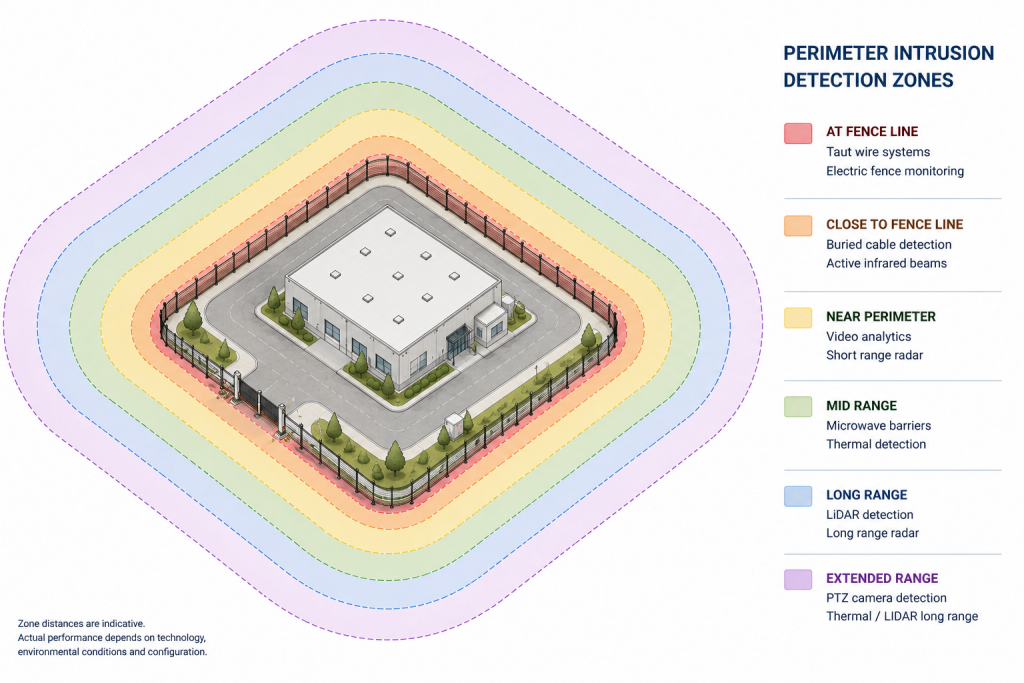
Detection Zoning
The perimeter should be divided into logical detection zones that enable security operators to quickly identify the location of an intrusion and initiate an appropriate response. Well-designed zoning improves situational awareness, simplifies fault diagnosis and reduces the time taken to verify and respond to alarms.
The size and configuration of each zone should reflect the operational requirements, perimeter layout and detection technology rather than simply dividing the perimeter into equal lengths.
Design Considerations
Zone Length
Detection zones should be of an appropriate length to accurately identify the location of an intrusion without creating unnecessary complexity. Longer zones reduce equipment costs but provide less precise alarm localisation, while shorter zones improve situational awareness at the expense of additional infrastructure.
Zone Boundaries
Zone boundaries should be positioned at logical physical features wherever possible, such as fence corners, gates, building interfaces or changes in perimeter construction. This simplifies maintenance and assists operators in identifying the affected area.
Gates & Access Points
Vehicle and pedestrian access points often require dedicated detection zones due to their unique operational characteristics. These areas may incorporate different sensing technologies and require independent alarm handling.
Detection Overlap
Where practical, adjacent zones should provide sufficient overlap to minimise blind spots and maintain detection coverage across transitions, corners and changes in perimeter direction.
Alarm Localisation
The system should provide sufficient information for operators or responding personnel to identify the approximate location of an intrusion without requiring unnecessary investigation. Integration with mapping systems, VMS or graphical interfaces can further improve situational awareness.
Zone Identification
Each detection zone should have a clear, unique identifier that corresponds with site drawings, maintenance documentation and alarm monitoring systems. Consistent naming conventions simplify operation, reporting and fault diagnosis.
Maintenance & Fault Finding
The zoning strategy should facilitate efficient testing and maintenance. Individual zones should be capable of being isolated for maintenance activities without unnecessarily affecting the remainder of the perimeter protection system.
Best Practice
- Divide the perimeter into logical operational zones rather than equal distances.
- Align zone boundaries with physical site features wherever possible.
- Provide dedicated zones for gates and other high-risk access points.
- Avoid unnecessary blind spots between adjacent zones.
- Ensure alarms clearly identify the affected perimeter section.
- Maintain consistent zone naming across drawings, software and documentation.
System Integration
A Perimeter Intrusion Detection System is most effective when integrated with complementary security systems that support rapid alarm verification, coordinated incident response and improved operator awareness. Integration requirements should be considered during the design stage to ensure compatibility between platforms and minimise unnecessary operator intervention.
Common Integrations
| Integration | Typical Purpose | Benefits | Design Considerations |
|---|---|---|---|
| CCTV | Automatically display or record cameras covering the affected perimeter zone. | Rapid visual verification, reduced false alarms and improved incident assessment. | Camera coverage, preset positions, recording quality and event synchronisation. |
| Video Management System (VMS) | Present alarms and associated video within a unified operator interface. | Improved situational awareness, simplified operation and comprehensive event recording. | Alarm mapping, ONVIF compatibility, event handling and operator workflows. |
| PTZ Camera Control | Automatically position PTZ cameras to the alarm location. | Faster assessment and reduced operator workload. | Preset accuracy, camera coverage and response time. |
| Access Control | Coordinate gates, barriers and controlled access points with perimeter alarms. | Improved site security, automated lockdown procedures and controlled response. | Alarm logic, authorised access, override procedures and event logging. |
| Physical Security Information Management (PSIM) | Combine perimeter alarms with multiple security systems into a common operational platform. | Automated workflows, improved decision making and coordinated incident management. | Rules engine configuration, standard operating procedures and system interoperability. |
| Intruder Alarm Systems | Correlate perimeter and internal intrusion events. | Layered detection, improved alarm confidence and reduced nuisance alarms. | Alarm priorities, confirmation logic and response procedures. |
| Security Lighting | Illuminate the affected perimeter zone following an alarm. | Improved camera performance and enhanced visual assessment. | Lighting levels, activation logic and energy management. |
| Remote Monitoring (ARC) | Transmit alarms to an Alarm Receiving Centre or remote control room. | Continuous monitoring and faster response outside normal operating hours. | Alarm transmission paths, communications resilience and escalation procedures. |
Design Considerations
When specifying system integrations, designers should consider:
- Compatibility between platforms and manufacturers.
- Open standards and communication protocols.
- Alarm priorities and event handling.
- Automatic camera call-up and visual verification.
- Operator workflows and user experience.
- Communications resilience and failover.
- Cyber security and authentication.
- Future expansion and interoperability.
Effective integration should simplify the operator’s response to an intrusion rather than increase complexity, ensuring alarms are presented with sufficient contextual information to support timely and informed decision making.
System Resilience
A Perimeter Intrusion Detection System should continue providing reliable detection during equipment failures, communications outages and power interruptions. The required level of resilience should reflect the operational importance of the protected site, recognising that undetected perimeter breaches may have significant security consequences.
Design Considerations
Power Resilience
Critical detectors, controllers, communications equipment and network infrastructure should be protected against power interruptions where continuous perimeter protection is required. Battery backup and UPS systems should be considered for business-critical or high-security sites.
Communications Resilience
The communication path between detectors, controllers and management platforms should be resilient to cable failures, network outages and communications faults. Where appropriate, redundant communications paths should be considered to maintain alarm reporting.
Detector Supervision
The system should continuously monitor the operational status of field devices and report faults such as detector failures, communication loss, tamper conditions and power faults. Fault monitoring enables maintenance issues to be identified before protection is compromised.
Environmental Resilience
Detection technologies should be selected and configured to operate reliably within the expected environmental conditions, including wind, rain, snow, fog, vegetation movement and temperature variation. Appropriate environmental compensation should minimise nuisance alarms while maintaining detection performance.
Network Resilience
Where IP-based detection systems are deployed, designers should consider the resilience of switches, network infrastructure and communications links. The failure of a single network component should not unnecessarily disable large sections of the protected perimeter.
Single Points of Failure
Critical sections of the perimeter should be assessed to identify components whose failure could result in the loss of detection across significant areas. Appropriate redundancy should be considered where the operational risk justifies the additional cost.
Business Continuity
The level of resilience should reflect the consequences of losing perimeter detection. Critical infrastructure, correctional facilities, military sites and other high-security environments may require higher levels of redundancy, fault tolerance and system availability than lower-risk commercial premises.
Best Practice
- Design resilience in proportion to the operational risk.
- Provide resilient power for critical field equipment and controllers.
- Supervise detectors, communications and power supplies for fault conditions.
- Select technologies appropriate for the environmental conditions.
- Minimise single points of failure where practical.
- Verify fault reporting and resilience during commissioning and acceptance testing.
Lifecycle Considerations
A perimeter intrusion detection system should continue providing reliable detection throughout changes to the site, environment and operational requirements. Regular maintenance, periodic review and proactive management help ensure detection performance is maintained throughout the system’s operational life.
Design Considerations
Future Expansion
The system should be designed to accommodate future extensions to the protected perimeter, additional detection zones and new integration requirements without requiring significant architectural changes.
Environmental Change
Perimeter environments naturally change over time through vegetation growth, landscaping, construction works and seasonal conditions. These changes can affect detector performance and should be considered when planning inspection and maintenance activities.
Detector Calibration
Many detection technologies require periodic calibration or adjustment to maintain optimum performance. Routine testing should verify that detection sensitivity remains appropriate while nuisance alarms are minimised.
Software & Firmware Lifecycle
Controllers, management platforms and field devices should be maintained throughout their operational life to improve reliability, introduce new functionality and address cyber security vulnerabilities. Updates should be planned to minimise disruption to operational protection.
Documentation
Accurate as-built drawings, zone schedules, detector locations, configuration records and maintenance documentation simplify testing, fault diagnosis and future expansion.
Performance Review
Detection performance should be reviewed periodically to identify trends in nuisance alarms, equipment faults and operational effectiveness. Regular reviews help ensure the system continues to meet the original operational requirements as the site evolves.
Whole-Life Cost
The total cost of ownership extends beyond the initial installation and includes preventative maintenance, detector replacement, software licensing, technical support, calibration, environmental management and future expansion. Design decisions should balance operational capability with long-term value.
Best Practice
- Design the system to support future perimeter expansion.
- Periodically inspect the protected perimeter for environmental changes.
- Test and calibrate detection technologies in accordance with manufacturer recommendations.
- Maintain accurate documentation throughout the system lifecycle.
- Monitor nuisance alarm rates and investigate recurring causes.
- Periodically review the system to ensure it continues to provide the required level of perimeter protection.
For guidance on managing a Perimeter Intrusion Detection System throughout their operational life, see Security Design Process – Lifecycle Management